Does Delegating SOL Mean Transferring Ownership? A Beginner-Friendly Explanation
28.10.2026
When a Solana wallet holder first encounters the option to delegate SOL, a reasonable fear often surfaces: does this action hand the tokens over to someone else? The short answer is no. Delegating SOL is fundamentally different from transferring ownership, though the distinction can appear blurred to newcomers navigating staking interfaces for the first time. Understanding this difference is the single most important step before committing funds to a validator.
The Core Distinction: Delegation Versus Transfer
At its simplest, transferring ownership means executing a standard SOL transfer to another wallet address. Once the network confirms that transaction, the sender has zero claim over those tokens. The recipient can immediately spend, stake, or burn them. The original owner retains no right to reverse the action or reclaim the funds.
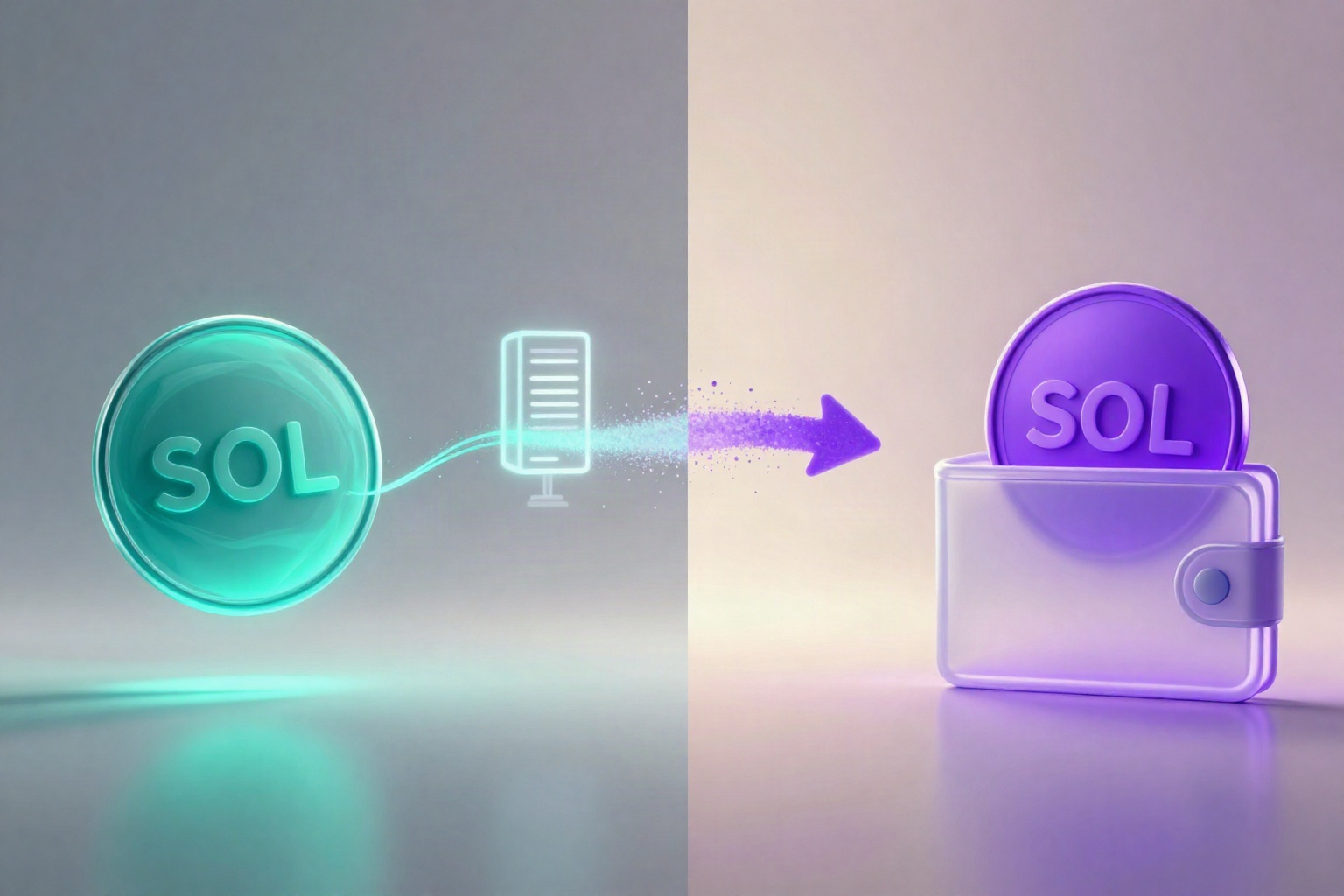
Delegating, by contrast, assigns the economic weight of your tokens to a validator’s vote account. You are lending your SOL’s influence to help secure the network, but the tokens remain locked in a stake account entirely under your control. The validator cannot spend your tokens, transfer them, or use them for any purpose other than voting on the state of the blockchain.
How Delegating SOL Actually Works
Solana’s architecture separates token custody from consensus participation. This design prevents validators from acting as custodians, eliminating a massive vector for theft or mismanagement.

Stake Accounts and Vote Accounts
When you delegate SOL, you do not send it to the validator’s main wallet. Instead, the protocol creates or updates a stake account derived from your own wallet address. The SOL moves from your standard system account into this stake account. You hold the authority keys to this stake account.
The validator operates a separate vote account. Your stake account points to the validator’s vote account, authorising it to include your SOL’s weight when it votes on blocks. The validator controls the vote account, but you control the stake account funding it.
The Lock-Up Mechanism
Delegation does render your SOL illiquid for a brief period. When you delegate, the tokens undergo a warming-up phase, which typically lasts one epoch (roughly two to three days on Solana). During this time, the tokens do not earn rewards and cannot be immediately spent. To access your SOL again, you must explicitly deactivate the stake, which triggers a cooling-down period of another epoch. Only after cooling down can the SOL be withdrawn back to your primary wallet.
What You Retain When You Delegate
Because you never surrender the private keys to your stake account, delegation preserves several critical rights:

- Custody: Your SOL never leaves an account you authorise. The validator cannot rug-pull your stake.
- Withdrawal rights: You can undelegate and move your SOL back to your main wallet at any time, subject only to the network’s epoch cooldown.
- Redelegation freedom: If a validator underperforms, you can deactivate your stake and move it to a different validator without ever withdrawing the tokens to your base wallet first.
- Reward accumulation: Staking yields are automatically credited to your stake account, compounding your balance without requiring a claim transaction.
What Transferring Ownership Really Means
Transferring SOL is an irreversible change of ledger state. You sign a transaction that decrements your balance and increments another. You yield every future right to those tokens. If you transfer SOL to a validator or a centralised exchange, you become an unsecured creditor. You rely entirely on their willingness and operational ability to return your funds. On-chain, there is no mechanism to claw back a standard transfer.
Transferring ownership gives the recipient absolute control. Delegating gives a validator temporary voting power while you keep the keys.
Choosing a Validator: Criteria That Matter
Since delegation preserves ownership, your primary task is selecting a competent validator. Not all validators operate with the same efficiency or integrity. Choosing poorly will not lose your principal, but it can severely diminish your returns.
| Evaluation Criterion | Why It Matters | What to Look For |
|---|---|---|
| Uptime and Reliability | Validators that miss blocks or skip votes do not earn rewards for their delegators during those periods. | A consistently high uptime score, typically above 95%, with minimal downtime over recent epochs. |
| Commission Rate | The commission is the percentage of your reward the validator keeps. High commissions erode yield. | A competitive but sustainable commission. Extremely low or 0% commissions may indicate a transient or subsidised operation that will raise rates later. |
| Network Decentralisation | Delegating to super-majority validators centralises the network, making it vulnerable to censorship or outages. | Validators outside the top tier by stake weight. Spreading stake strengthens the network's resilience. |
Performance and Uptime
A validator’s core job is to vote on every block. If their hardware or network connection falters, they skip votes. Skipped votes directly translate to missed staking yield for you. Review a validator’s historical skip rate before committing. A validator with a 99% vote success rate will consistently outperform one with a 90% rate, even if the latter charges zero commission.

Commission Rates
Commission structures vary widely. A 10% commission is relatively high, while 5% to 7% is standard. Some validators offer 0% or 1% to attract stake quickly. Evaluate these rock-bottom rates with caution. Running a high-performance validator node is expensive; operators must cover server costs and developer time. Unsustainably low commissions often lead to underfunded infrastructure, eventually degrading uptime and costing you more in lost rewards than the commission savings provided.
Decentralisation Metrics
The health of the Solana blockchain depends on stake being distributed across many independent validators. If a single entity or data centre controls too much stake, the network becomes prone to outages. By deliberately delegating to smaller, independent validators with solid uptime, you earn a competitive yield while actively improving the network’s fault tolerance.
Limitations and Risks of Delegation
While safer than transferring ownership, delegation is not without constraints. The most immediate limitation is illiquidity. Your SOL is locked for the duration of the warm-up and cool-down periods. If you need rapid access to your funds to trade or deploy in a decentralised application, the epoch delay can be a significant hindrance.
Additionally, the Solana network does not currently implement widespread slashing for downtime. Slashing—the automatic destruction of a portion of delegated stake as a penalty—is common on other proof-of-stake networks. On Solana, a validator’s poor performance merely results in missed rewards, not a loss of your initial principal. However, protocol upgrades could introduce slashing for severe offences like double-signing in the future, meaning delegators must remain aware of the validator’s operational security practices.

Making the Right Decision for Your SOL
The decision to delegate or transfer hinges on your goals and risk tolerance. If you intend to stake and earn yield while maintaining self-custody, delegation is the only appropriate on-chain mechanism. You retain full command of your assets, bounded only by the temporary epoch lock-up required to maintain network stability.
Transferring ownership should be reserved strictly for situations where you intend to pay for a service, send funds to another person, or deliberately move assets to a centralised platform for trading—understanding that you surrender on-chain control in the process. Never transfer SOL to a validator address expecting them to stake it on your behalf; legitimate non-custodial staking never requires you to give up your tokens.
For additional context before acting, a closer look at the mechanics of building a SOL position. Confirm that the referenced information is current before relying on details such as fees, support or timing.
Delegating SOL is an assertion of ownership, not a relinquishment of it. By carefully selecting validators based on performance and sustainable commission models, you put your assets to work without compromising your sovereignty over them.
